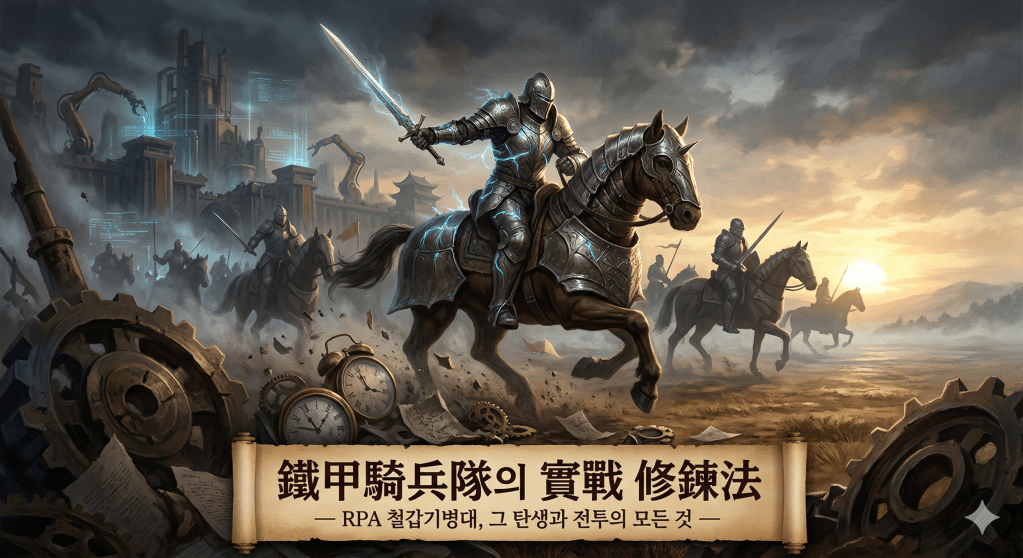
鐵甲騎兵隊의 實戰 修鍊法
— RPA 철갑기병대, 그 탄생과 전투의 모든 것 —
“천 번 달구고 만 번 두드려야 비로소 명검(名劍)이 된다.
자동화도 그러하니, 한 번에 완성되는 병기는 없다.”
서문(序文) — RPA라는 병기의 본질, 철갑기병대란 무엇인가
중원에는 수많은 병기가 있었다.
창(ERP)은 길고 단단하여 전체 진형을 다스렸고, 방패(MES)는 현장을 지켰으며, 활(데이터 분석)은 먼 곳의 적을 내다보았다. 그런데 이 모든 병기들 사이에는 언제나 채워지지 않는 공백이 있었다.
반복되는 잡무(雜務).
매일 아침, 수십 명의 병사들이 전쟁과 무관한 일에 소모되고 있었다. ERP에서 데이터를 뽑아 엑셀에 붙여 넣고, MES에서 생산 실적을 취합하여 보고서를 만들고, 구매 발주 내역을 시스템에 하나하나 입력하고, 품질 데이터를 이 창고에서 저 창고로 옮겨 담는 일들.
그것은 전투가 아니었다. 소모(消耗)였다.
연간으로 계산하니, 그 소모의 크기가 실로 경악할 수준이었다. 무려 12,000시간 — 숙련된 병사 여섯 명이 일 년 내내 칼 한 번 빼지 못하고 잡무에 묶여 있는 것과 같은 시간이었다.
그때 나는 새로운 병기의 소식을 들었다.
RPA(Robotic Process Automation) — 로봇이 사람 대신 반복 업무를 수행하는 디지털 병기.
나는 이것을 철갑기병대(鐵甲騎兵隊) 라 명명하였다.
철갑기병대는 사람이 아니다. 지치지 않고, 잠들지 않으며, 실수하지 않는다. 오직 명령받은 초식(招式)만을 완벽하게 반복 수행한다. 그러나 그것이 동시에 이 병기의 한계이기도 하다 — 스스로 판단하지 못하며, 예외 앞에서는 멈추어 선다.
따라서 철갑기병대를 제대로 운용하려면 세 가지를 알아야 한다.
어떤 전투에 투입할 것인가, 어떻게 단련시킬 것인가, 그리고 어떻게 살아남게 할 것인가.
이 수련서는 그 세 가지의 기록이다.
수련 1 (修鍊一) — 어떤 초식(업무)에 RPA를 써야 하는가
“명장은 병기를 가리지 않는다. 그러나 용도를 가린다.”
철갑기병대를 처음 배치받은 장수들이 흔히 저지르는 실수가 있다.
“이 병기는 강하니, 모든 전투에 쓸 수 있을 것이다.”
아니다. 철갑기병대는 특정한 지형(地形)에서만 무적이다. 그 지형을 벗어나면 오히려 짐이 된다.
나는 수련 끝에 네 가지 지형의 법칙(四地之法) 을 정립하였다.
四地之法 — RPA에 적합한 네 가지 전투 지형
첫째, 반복의 땅(反復之地)
같은 동작을 하루에도 수십, 수백 번 반복하는 업무다. 매일 아침 ERP에서 전날 생산 실적을 뽑아 보고서 양식에 채워 넣는 일, 월말마다 수십 개 거래처의 세금계산서 데이터를 취합하는 일이 이에 해당한다. 철갑기병은 지치지 않는다. 반복이 많을수록 전과(戰果)가 커진다.
둘째, 규칙의 땅(規則之地)
“만약 A이면 B를 하라”는 명확한 판단 기준이 있는 업무다. 원자재 재고가 기준치 이하면 자동 발주를 생성하고, 생산 실적이 목표 대비 일정 수준 이하면 알림을 보내는 일이 이에 해당한다. 규칙이 명확할수록 철갑기병은 빛을 발한다.
셋째, 다량의 땅(多量之地)
처리해야 할 건수가 많아 사람의 손으로는 한계가 있는 업무다. 한 달에 수천 건의 구매 발주 내역을 ERP에 입력하는 일, 수백 개 협력사의 납기 현황을 취합하는 일이 여기에 속한다. 건수가 많을수록 철갑기병의 가치는 기하급수적으로 올라간다.
넷째, 안정의 땅(安定之地)
업무의 규칙과 양식이 자주 바뀌지 않는 곳이다. 철갑기병은 훈련받은 대로만 움직인다. 매달 규칙이 바뀌는 업무에 투입하면, 훈련비용이 전과를 초과하는 낭비가 발생한다.
반대로, 투입하면 안 되는 네 가지 금지 지형(四禁之地) 도 있다.
❌ 판단의 땅 — 사람의 직관과 경험이 필요한 의사결정 업무
❌ 예외의 땅 — 케이스마다 처리 방식이 다른 복잡한 업무
❌ 변화의 땅 — 시스템이나 양식이 자주 바뀌는 불안정한 환경
❌ 관계의 땅 — 고객·협력사와의 소통이 핵심인 대인(對人) 업무
이 四禁之地에 철갑기병을 투입하면 반드시 패한다. 나는 이것을 여러 번의 시행착오 끝에 배웠다.
선정의 실전 도구 — 병사 선발 기준표 (RPA 과제 선정 매트릭스)
| 평가 항목 | 배점 | 판별 기준 |
| 반복 빈도 | 30점 | 일 10회 이상 = 30점 / 주 1회 = 5점 |
| 규칙 명확성 | 25점 | 예외 5% 미만 = 25점 / 30% 이상 = 0점 |
| 처리 건수 | 25점 | 월 500건 이상 = 25점 |
| 시스템 안정성 | 20점 | 1년 이상 변경 없음 = 20점 |
| 합계 70점 이상 | — | 우선 투입 대상 |
| 합계 40점 미만 | — | 투입 보류 |
이 기준표를 손에 쥐고, 나는 전장으로 나아갔다.
수련 2 (修鍊二) — 실전 배치, 24개 공정·12,000시간의 실제 전투
“하나를 이기면 둘이 두렵지 않고, 열을 이기면 백이 두렵지 않다.”
첫 번째 전투는 소박하였다.
생산 실적 보고서 자동 생성.
매일 아침 7시, 담당 병사가 MES와 ERP를 오가며 전날 생산 실적을 취합해 보고서를 만드는 일이었다. 한 번에 40분, 일 년이면 200시간이 소모되는 단순 반복 업무였다.
나는 이것을 첫 번째 철갑기병에게 맡겼다.
사흘 동안 수련시켰다. 버그를 잡고, 예외 처리를 추가하고, 검증을 반복하였다. 그리고 네 번째 날 아침, 철갑기병은 홀로 일어나 보고서를 완성하였다.
7시 정각, 단 3분 만에.
담당 병사는 멍하니 서 있었다. 그의 표정에는 기쁨과 당혹감이 뒤섞여 있었다. 나는 그에게 말하였다.
“그대가 아낀 200시간으로 이제 더 중요한 전투를 준비하라.”
첫 승전(勝戰)은 용기를 낳았다. 나는 전선을 넓혔다.
제조업 현장에서 벌어지는 24개 전투, 그 모두에 철갑기병을 배치하였다. 주요 전투 기록은 다음과 같다. 더욱 가공할 성과는 RPA Bot은 하나의 적진(반복업무)만에
투입하는 것이 아니라, 계획을 잘 짜면 여러 적진을 차례로 투입할 수 있다는 것이다. 이 얼마나 기특한 병기인가…
24개 전투 기록부 (주요 전과)
| 전투명 | 적진(반복 업무) | 투입 병기 | 탈환 시간 |
| 1전 | 일일 생산 실적 보고서 자동 생성 | RPA Bot #1 | 연 200시간 |
| 2전 | 구매 발주 데이터 ERP 자동 입력 | RPA Bot #2 | 연 650시간 |
| 3전 | 월말 세금계산서 취합 및 대사 | RPA Bot #3 | 연 480시간 |
| 4전 | 원자재 재고 현황 자동 취합·배포 | RPA Bot #4 | 연 310시간 |
| 5전 | MES→ERP 생산 데이터 자동 이관 | RPA Bot #1 | 연 720시간 |
| 6전 | 협력사 납기 현황 자동 수집·정리 | RPA Bot #2 | 연 380시간 |
| 7전 | 품질 검사 데이터 자동 분류·저장 | RPA Bot #3 | 연 290시간 |
| 8전 | 급여 계산 전처리 데이터 자동화 | RPA Bot #4 | 연 260시간 |
| … | (이하 16개 전투 계속) | … | … |
| 합계 | 24개 업무 완전 자동화 | 4개 Bot | 연 12,000시간 |
12,000시간. 이것은 단순한 숫자가 아니었다.
숙련된 병사 5.7명이 1년 내내 쉬지 않고 일하는 시간이었다. 그 시간이 기계의 손으로 넘어가는 순간, 사람의 손은 자유로워졌다.
그러나 이 24번의 전투가 모두 순탄하지는 않았다.
MES와 ERP 사이의 데이터 연동 전투에서는 예외 케이스가 쏟아져 나와 철갑기병이 세 차례나 멈추어 섰다. 세금계산서 처리 전투에서는 협력사마다 양식이 달라 수련 기간이 예상의 두 배로 늘어났다. 협력사 납기 현황 수집 전투에서는 일부 협력사 시스템이 크롤링을 차단하여 전략을 전면 수정하여야 했다.
전쟁은 항상 계획대로 흘러가지 않는다.
그것이 수련 3의 주제다.
수련 3 (修鍊三) — 실패하는 RPA vs 살아남는 RPA
“검이 부러지는 것은 쇠가 약해서가 아니라, 잘못 단련했기 때문이다.”
중원의 수많은 성채들이 RPA를 도입하였다가 조용히 폐기하였다.
나는 그 패인(敗因)들을 수집하고 분석하였다. 그리고 실패하는 RPA와 살아남는 RPA 사이에는 다섯 가지 결정적 차이가 있음을 발견하였다.
실패하는 RPA의 5가지 죽음
첫째 죽음 — 화려한 업무부터 자동화하려는 욕심
임원 보고용 대시보드, 전략적 분석 리포트 — 이런 복잡하고 가시적인 업무를 첫 타깃으로 삼는 경우다. 예외가 많고 판단이 필요한 업무에 투입된 철갑기병은 첫 달부터 오류를 쏟아낸다. 결국 “RPA는 쓸모없다”는 낙인이 찍힌다.
→ 살아남는 RPA: 가장 단순하고 반복적인 업무부터 시작하여 첫 승전을 만들어라. 작은 승리가 조직의 신뢰를 낳는다.
둘째 죽음 — IT팀 혼자 만들고, 현업은 모르는 bot
IT팀이 모든 것을 기획하고 구현하여 현업에 건네주는 방식이다. 현업은 자신이 관여하지 않은 도구를 신뢰하지 않는다. 오류가 생기면 “IT가 만든 거니까 IT가 고쳐야지”라며 외면한다. 결국 아무도 돌보지 않는 bot이 된다.
→ 살아남는 RPA: 현업 담당자를 공동 설계자로 세워라. 그들이 수련에 참여한 bot은 그들의 병기가 된다.
셋째 죽음 — 예외 처리를 포기한 봇
“예외가 생기면 그냥 멈추게 하면 되지”라는 안일한 설계다. 처음엔 문제없어 보인다. 그러나 현업은 bot이 멈출 때마다 원망하고, 결국 “차라리 내가 하는 게 낫겠다”며 손을 거둔다.
→ 살아남는 RPA: 예외 발생 시 담당자에게 즉시 알림을 보내고, 예외 케이스를 기록·누적하여 주기적으로 수련을 강화하라. 예외 처리가 bot의 내공(內功)이다.
넷째 죽음 — 관리 주체가 없는 고아 bot
RPA를 도입하였으나 누가 관리하는지 정해지지 않은 경우다. 시스템이 업그레이드되고, 업무 양식이 바뀌면 bot은 오작동한다. 고쳐야 할 사람이 없으니 그대로 방치된다.
→ 살아남는 RPA: RPA CoE(사령부) 를 설치하라. 최소 한 명의 전담 관리 장수가 있어야 철갑기병대는 오래 살아남는다.
다섯째 죽음 — ROI를 측정하지 않는 자만
“잘 되고 있겠지”라는 막연한 믿음으로 운영하는 경우다. ROI를 측정하지 않으면 경영진의 지원이 끊기고, 예산이 사라지며, 결국 철갑기병대는 해산된다.
→ 살아남는 RPA: 매 분기 탈환 시간과 비용 절감을 수치화하여 조정(경영진)에 보고하라. 숫자가 철갑기병대의 생존을 보장한다.
살아남는 RPA의 3가지 체질
| 체질 | 내용 |
| 단순함 | 첫 bot은 가장 단순한 초식부터. 복잡함은 내공이 쌓인 후에 |
| 공동 소유 | IT와 현업이 함께 만든 bot만이 오래 쓰인다 |
| 지속 단련 | bot도 수련을 멈추면 녹슨다. CoE가 지속적으로 강화하라 |
📜 결어(結語) — 철갑기병대 이후, 다음 전장으로
“한 병기를 완성한 자는 다음 병기의 꿈을 꾼다.”
12,000시간을 탈환하였을 때, 나는 한동안 그 숫자 앞에 서 있었다.
5.7명의 병사가 1년간 할 일을 기계가 대신하게 된 것이다. 그 병사들은 이제 더 높은 가치의 전투로 나아갈 수 있었다. 데이터를 분석하고, 개선안을 찾고, 고객과 마주하는 일로.
그러나 기쁨은 오래 가지 않았다.
철갑기병대가 정복한 땅 너머로, 더 크고 어두운 전장이 펼쳐져 있었기 때문이다.
RPA가 처리할 수 있는 것은 정해진 규칙 안의 반복뿐이었다. 그러나 진짜 제조 현장의 문제들 — 불량의 원인을 찾고, 수요를 예측하고, 설비의 이상 징후를 미리 감지하는 일 — 은 규칙 밖에 있었다. 그것은 판단(判斷) 의 영역이었다.
그 전장의 이름이 바로 AI(인공지능) 였다.
나는 RPA를 통해 조직이 자동화를 받아들이는 법을 배웠고, 데이터를 정비하는 법을 익혔으며, 거버넌스를 세우는 훈련을 하였다. 그 모든 것이 AI라는 다음 전장을 위한 준비였음을 이제는 안다.
철갑기병대는 끝이 아니라, 시작이었다.
Vision AI로 드럼 라벨 검사를 자동화하여 정확도 98.7%를 달성한 전투도, Private GenAI 플랫폼으로 ROI 235%를 거둔 전투도, 모두 이 12,000시간의 탈환에서 시작된 여정의 산물이었다.
그대가 지금 RPA 앞에 서 있다면, 이것을 기억하라.
“철갑기병대를 단련하는 것은 단지 시간을 아끼기 위함이 아니다.
그것은 그대의 조직이 다음 전장을 감당할 수 있는 체질을 만드는 수련이다.”
12,000시간의 탈환은 끝났다.
다음 전장은 이미 시작되었다.
다음 연재: “Vision AI 98.7%의 비밀 — 눈 없는 검사관이 사람을 이긴 날”
12,000 Hours of Reclamation
The actual fighting method of the iron and steel cavalry.
— RPA Ironclad Cavalry , Everything About Its Birth and Battles —
“It takes heating a thousand times and hammering ten thousand times to become a legendary sword.
The same is true of automation; no weapon is perfected in a single stroke.”
Preface — The Essence of the Weapon Called RPA, What Is Ironclad Cavalry?
There were numerous weapons in the Central Plains.
The spear (ERP) was long and sturdy, commanding the entire formation; the shield (MES) guarded the battlefield; and the bow (Data Analysis) foresaw enemies in the distance. However, there was always an unfilled void between all these weapons.
Repetitive chores.
Every morning, dozens of soldiers were being consumed by tasks unrelated to the war. Tasks such as extracting data from the ERP system and pasting it into Excel, compiling production results from the MES to generate reports, entering purchase orders into the system one by one, and transferring quality data from one warehouse to another.
It was not a battle. It was attrition.
When calculated on an annual basis, the scale of the expenditure was truly astonishing. A whopping 12,000 hours —equivalent to six skilled soldiers being tied up in menial tasks for an entire year without ever drawing their swords.
At that time, I heard news of a new weapon.
RPA (Robotic Process Automation) — A digital weapon where robots perform repetitive tasks instead of humans.
named this the Ironclad Cavalry .
Ironclad cavalry is not human. They tire, sleep, and make no mistakes. They perfectly repeat only the techniques ordered to them. However, this is simultaneously the limitation of this weapon—it cannot make its own judgments and stops before exceptions.
Therefore, to properly operate armored cavalry, you must know three things.
Which battle to deploy them in, how to train them, and how to make them survive.
This training manual is a record of those three things.
Training 1 — Which Techniques (Tasks) Should RPA Be Used?
A great general does not discriminate against weapons. However, he discriminates against their uses.
There is a common mistake made by commanders who are first assigned armored cavalry .
This weapon is powerful, so it can be used in every battle.
No. Ironclad cavalry is invincible only in specific terrain. Outside of that terrain, they actually become a burden.
After training, I established the laws of the four terrains .
The Law of the Four Battle Terrains — Four Combat Terrains Suitable for RPA
it is work that involves repeating actions dozens or hundreds of times a day, akin to a “land of repetition.”
This includes tasks such as extracting the previous day’s production figures from the ERP system every morning and filling them into report forms, or compiling tax invoice data from dozens of clients at the end of every month . Ironclad cavalry never tires. The more repetition there is, the greater the results.
Second, the land of rules—
tasks with clear judgment criteria such as “if A, do B.” This includes tasks like automatically generating orders when raw material inventory falls below a threshold and sending alerts when production performance falls below a certain level relative to the target. The clearer the rules, the more the armored cavalry shines.
Third, regarding “massive tasks,”
this is work where the sheer volume of items to be processed exceeds the limits of human capability. This includes tasks such as entering thousands of purchase orders into the ERP system every month and compiling delivery statuses from hundreds of partner companies. As the volume increases, the value of the armored cavalry rises exponentially.
Fourth, a land of stability
is a place where the rules and practices of operations do not change frequently. Ironclad cavalry is They act only as they were trained to . If deployed to tasks where rules change every month, it results in a waste where training costs exceed the performance.
Conversely, there are also four forbidden terrains where one must not deploy .
❌ Land of Judgment — Decision-making tasks requiring human intuition and experience
❌ Land of exceptions — Complex tasks that require different processing methods
for each case ❌ Land of Change — An unstable environment where systems or patterns frequently change
❌ The Land of Relationships — Interpersonal work where communication with customers and partners is key
armored cavalry into this Four Forbidden Zone, you will surely lose. I learned this after many trials and errors.
Practical Selection Tool — Soldier Selection Criteria (RPA Task Selection Matrix)
| Evaluation items | Points | Identification criteria |
| Repetition frequency | 30 points | 10 or more times a day = 30 points / 1 time a week = 5 points |
| Rule clarity | 25 points | Exceptions: Less than 5% = 25 points / 30% or more = 0 points |
| Number of processed cases | 25 points | More than 500 cases per month = 25 points |
| System stability | 20 points | No change for more than 1 year = 20 points |
| Total of 70 points or more | — | Priority deployment targets |
| Total less than 40 points | — | Input withheld |
Holding this standard chart in my hand, I marched into the battlefield.
Training 2 — Deployment, 24 Processes · 12,000 Hours of Actual Combat
“If you defeat one, you do not fear two; if you defeat ten, you do not fear a hundred.”
The first battle was modest.
Automatic generation of production performance reports.
Every morning at 7 a.m., the soldier in charge would switch between the MES and ERP systems to compile the previous day’s production results and create a report. It was a simple, repetitive task that took 40 minutes at a time, amounting to 200 hours a year.
I entrusted this to the first armored cavalry.
He was trained for three days . Bugs were fixed, exception handling was added, and verification was repeated. And on the morning of the fourth day, the armored cavalryman stood up alone and completed the report.
At exactly 7 o’clock, in just 3 minutes.
The soldier in charge stood there blankly. His expression was a mixture of joy and bewilderment. I spoke to him.
Use the 200 hours you saved to prepare for a more important battle.
The first victory gave rise to courage. I expanded the front line.
Armored cavalry was deployed to all 24 battles taking place in the manufacturing site . The records of major battles are as follows. An even more formidable achievement is that the RPA Bot [attacked] a single enemy base ( repetitive tasks )
It means that instead of deploying them one by one, if you plan well, you can deploy them into multiple enemy positions in sequence. What a remarkable weapon this is …
24 Combat Records (Major Achievements)
| Battle name | enemy territory (repetitive tasks) | Weapons deployed | Recapture time |
| 1 game | Automatic generation of daily production performance reports | RPA Bot #1 | 200 hours per year |
| 2 games | Automatic ERP entry of purchase order data | RPA Bot #2 | 650 hours per year |
| 3 games | Monthly tax invoice collection and reconciliation | RPA Bot #3 | 480 hours per year |
| 4 games | Automatic collection and distribution of raw material inventory status | RPA Bot #4 | 310 hours per year |
| 5 games | Automatic migration of production data from MES to ERP | RPA Bot #1 | 720 hours per year |
| 6 games | Automatic collection and organization of partner delivery status | RPA Bot #2 | 380 hours per year |
| 7 games | Automatic classification and storage of quality inspection data | RPA Bot #3 | 290 hours per year |
| 8 games | Automation of payroll calculation preprocessing data | RPA Bot #4 | 260 hours per year |
| … | (16 more battles follow) | … | … |
| total | Fully automated 24 tasks | 4 Bots | 12,000 hours per year |
12,000 hours. This was not just a simple number.
skilled soldiers worked tirelessly for a whole year . The moment that time was transferred to the hands of machines, human hands became free.
However, not all of these 24 battles went smoothly.
In the battle for data integration between MES and ERP, a flood of exception cases caused the armored cavalry to halt three times. In the battle for tax invoice processing, the training period doubled compared to expectations because the forms varied by partner company . In the battle to collect partner delivery status data, some partner systems blocked crawling , forcing a complete revision of the strategy.
War does not always go according to plan.
That is the theme of Training 3.
Training 3 — Failing RPA vs. Surviving RPA
A sword breaks not because the iron is weak , but because it was forged incorrectly.
Numerous fortresses in the Central Plains adopted RPA and then quietly abandoned it.
I discovered that there are five critical differences between failing RPA and surviving RPA .
The 5 Deaths of Failing RPA
The first death—the greed to automate glamorous tasks first.
This occurs when complex and visible tasks, such as executive dashboards and strategic analysis reports, are targeted first. When deployed to tasks with many exceptions and requiring judgment , this armored cavalry spews out errors from the very first month. Ultimately, it gets branded as “RPA useless .”
Surviving RPA: Start with the simplest and most repetitive tasks to secure your first victory. Small victories build organizational trust.
The Second Death — A bot created solely by the IT team, unknown to the business units
. This is a method where the IT team plans and implements everything before handing it over to the business units. The business units do not trust tools they were not involved in. When an error occurs, they turn a blind eye, saying, “IT made it, so IT should fix it .” Ultimately, it becomes a bot that no one takes care of.
Surviving RPA: Appoint business users as co-designers. The bots they train become their weapons.
Third Death — A bot that abandoned exception handling . It is a complacent design based on the idea that “if an exception occurs, we can just make it stop.” At first, it seems fine. However, the business team resents the bot every time it stops, and eventually
gives up , saying, “I’d rather just do it myself.”
→ Surviving RPA: Immediately notify the person in charge when an exception occurs, and record and accumulate exception cases to periodically reinforce training. Exception handling is the bot’s inner strength.
Fourth Death — Orphan Bots with No Management Entity:
This occurs when an RPA system is introduced but no one is designated to manage it. When the system is upgraded or work procedures change, the bot malfunctions. Since there is no one to fix it, it is left neglected.
Surviving RPA: Establish an RPA CoE (Command Center) . There must be at least one dedicated commander to ensure the long survival of the Ironclad Cavalry.
The fifth death—this is the case where one operates based on the vague belief that “things must be going well,” without measuring ROI
. If ROI is not measured, management support is cut off, the budget disappears, and eventually, the armored cavalry is disbanded.
Surviving RPA: Quantify quarterly recapture time and cost savings and report them to management. The numbers guarantee the survival of the armored cavalry.
3 Constitutions of Surviving RPA
| constitution | detail |
| Simplicity | Start with the simplest techniques for the first bot. Complexity comes after internal energy has been built up. |
| Joint ownership | Only bots created jointly by IT and business units are used for a long time. |
| Continuous training | Even bots rust if they stop training. Continuously reinforce the CoE . |
📜 Conclusion — After the Ironclad Cavalry , to the Next Battlefield
He who has perfected one weapon dreams of the next.
When I reclaimed 12,000 hours, I stood before that number for a while.
Machines took over the work of 5.7 soldiers for a year. Those soldiers were now able to advance to higher-value battles: analyzing data, finding solutions for improvement, and engaging with customers.
However, the joy did not last long.
beyond the land conquered by the armored cavalry, a larger and darker battlefield stretched out.
RPA could only handle repetition within defined rules . However, the real problems of the manufacturing floor—finding the causes of defects, forecasting demand, and detecting signs of equipment anomalies in advance—were outside the rules. It was a realm of judgment .
The name of that battlefield was AI (Artificial Intelligence) .
Through RPA, I learned how organizations embrace automation, mastered data organization, and trained in establishing governance. I now realize that all of this was preparation for the next battlefield: AI.
The armored cavalry was not the end, but the beginning.
The battle to achieve 98.7% accuracy by automating drum label inspection with Vision AI, and the battle to achieve an ROI of 235% with the Private GenAI platform, were both the products of the journey that began with this 12,000-hour recapture.
If you are standing in front of RPA right now, remember this.
Training armored cavalry is not merely to save time.
It is a discipline to build the constitution of your organization capable of handling the next battlefield.
The 12,000-hour recapture is over.
The next battle has already begun.
Next Series: “The Secret of Vision AI’s 98.7% — The Day an Eyeless Inspector Beat a Human”


답글 남기기